 اللغة العربية
 Български
 Čeština
 Dansk
Dansk Deutsch
 Ελληνικά
 English
 Español
 Suomi
Suomi Français
 हिन्दी
 Magyar
 Italiano
 日本語
日本語 한국어
한국어 Nederlands
 Norsk
Norsk Polski
 Português
 Română
 Русский
 Svenska
 ภาษาไทย
 Türkçe
 中文
中文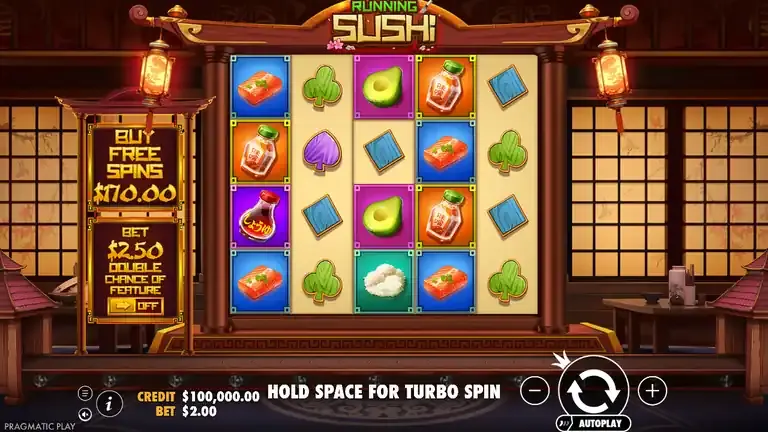
I'm Mia Stone, and Running Sushi sits well outside my usual Egypt-and-Hold-and-Win territory. It's a Pragmatic Play slot built around a Japanese restaurant, and the thing that immediately distinguishes it from the rest of the PP catalog is the conveyor belt running along the bottom of the reels: five or six sushi-shaped tokens, each with a money multiplier printed on its face, cycling on the belt every spin before results even settle. That belt is live from the very first base spin - not a bonus-only gimmick - and it changes how I read every result. I ran 1,623 spins in the Pragmatic Play demo to understand when and how the two layers actually connect.
The Setup - Grid, Symbols, and the Conveyor Belt
The grid is 5x4, 1,024 ways to win, no paylines to count. The symbol tier is standard Pragmatic issue - card suits at the low end, food icons in the middle, premium sushi pieces at the top, and a Golden Wild that substitutes for standard symbols.
What sets the layout apart is the conveyor belt below the grid. Five or six tokens sit on that belt each spin, and each one shows a money multiplier on its face - values ranging from 1x to 1,000x stake in the base game. Those values change with every spin. The belt is purely display unless a collector symbol lands on the reels. Without one, the tokens cycle and their values do not contribute to the round.
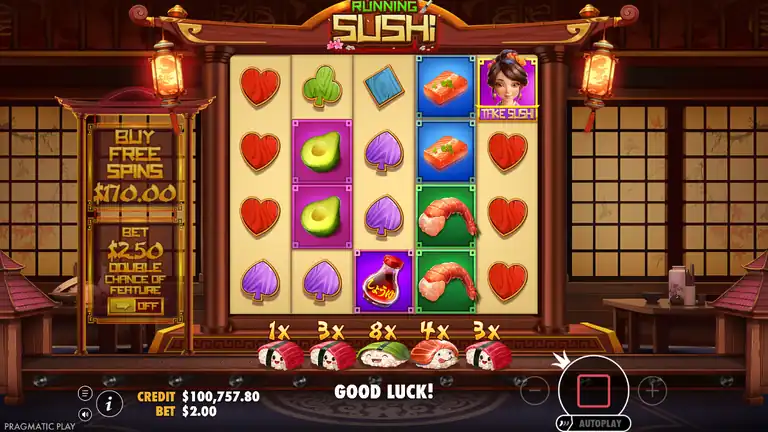
There are two collector symbols. The Take Sushi symbol - a female waitress in a restaurant uniform, labeled clearly when she lands - appears on reels 1, 3, and 5 in both base play and free spins. When she lands, she picks up individual conveyor token values from the belt. The Take All symbol (a heavyset male chef, labeled "TAKE ALL" beneath when landing) is free spins only and appears on reels 2, 3, and 4. He collects the entire accumulated total from the left-panel meter in a single hit.
The Collection Mechanic in Practice
The belt is what this game is actually about. A normal reel spin with no collector landing pays out through the 1,024-ways mechanism only - whatever sits on the belt is irrelevant to that round. The moment Take Sushi lands, one or more belt token values convert to a cash prize added to the round's total.
The size of that cash prize depends on two things at once: which token values happen to be on the belt that spin, and whether Take Sushi lands at all. A 100x token on the belt with Take Sushi on reel 3 is a 100x-stake prize on top of any reel win. A 500x token on the belt with no Take Sushi that spin pays nothing from the belt. That gap - between what is sitting on the belt and whether a collector actually fires - is where most of the session-to-session variance lives in the base game.
It is a mechanical frustration built into the design. I watched high values cycle on the belt for spin after spin with no collector landing to take them. In the bonus, the math goes up: conveyor values can reach 2,500x stake during free spins. A Take All landing when the meter has built on high belt values is where the session swings come from.
Bet range, per VegasSlotsOnline (community aggregator - Pragmatic Play's own page does not display the range directly), starts from $0.20 per spin up to a stated $300 per spin. I ran this session at $2.00 per spin throughout.
Free Spins - What Changes in the Bonus
Three or more Sushi Chef scatter symbols anywhere on the reels trigger 10 free spins - flat count, no variable trigger.
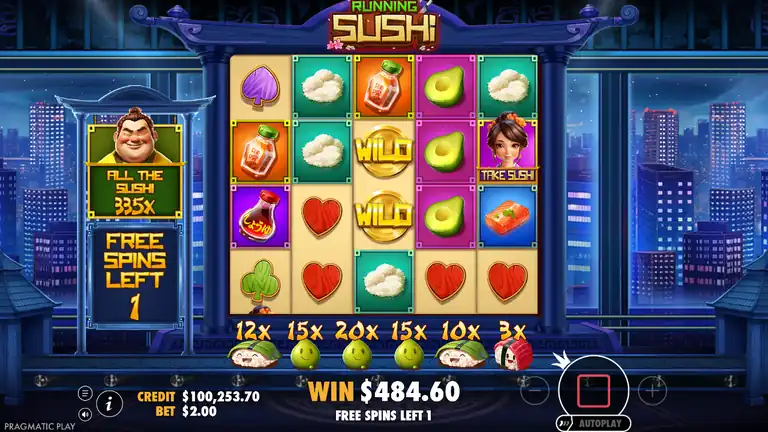
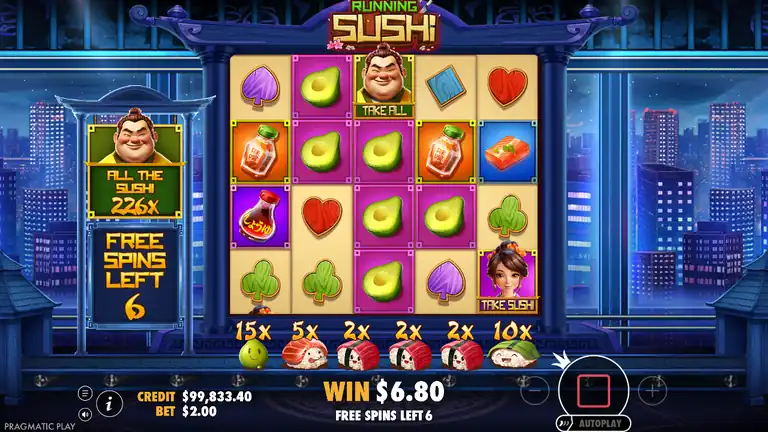
The background shifts immediately when the round starts. The warm Japanese restaurant setting cuts to a night city exterior - darker, cooler, with building lights through the windows. Simultaneously, the left-side panel replaces the Buy Free Spins and Ante Bet controls with two new counters: the "ALL THE SUSHI!" accumulator meter at the top, and a "FREE SPINS LEFT N" countdown below.
The conveyor belt stays active in free spins, but values escalate noticeably - up to 2,500x stake per token rather than 1,000x in the base game. The Take All symbol (the fat chef) becomes available on reels 2, 3, and 4. He collects the full accumulated meter value in one event - as opposed to Take Sushi, who collects individual belt tokens. The tension is in the sequencing: if Take Sushi bleeds individual values off the belt while the meter is building, the Take All arrives with less accumulated than it might have.
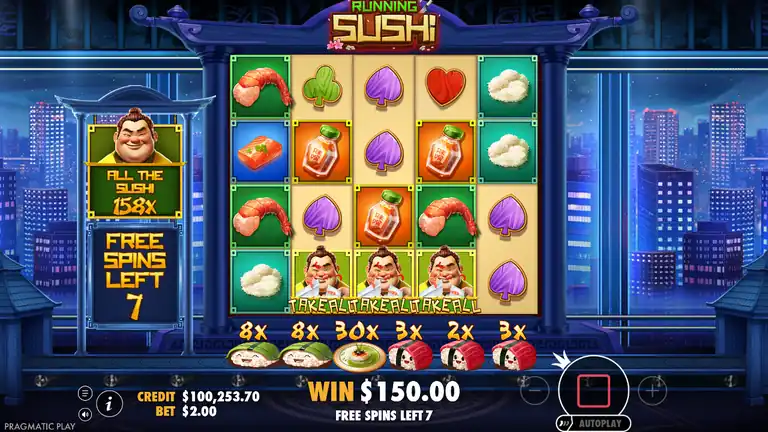
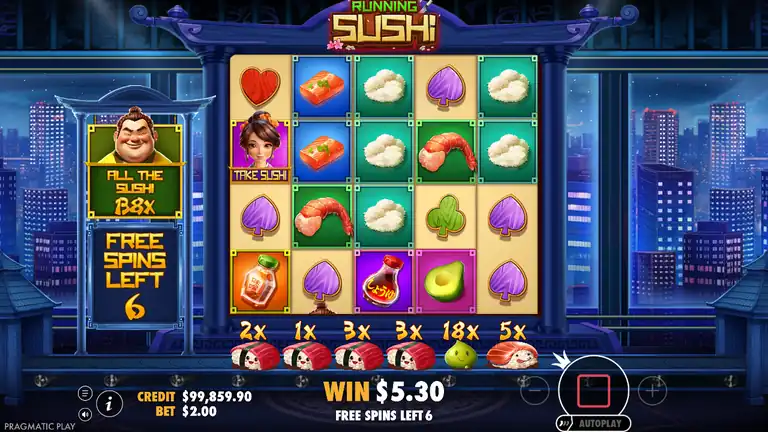
No retriggers occurred across the 8 bonus rounds I tracked in this session. No multiplier stacking either - every individual free spin within each bonus round had a flat 1x multiplier. The payout came purely from money symbol accumulation, not from any escalating spin multiplier.
Buy Bonus and Ante Bet
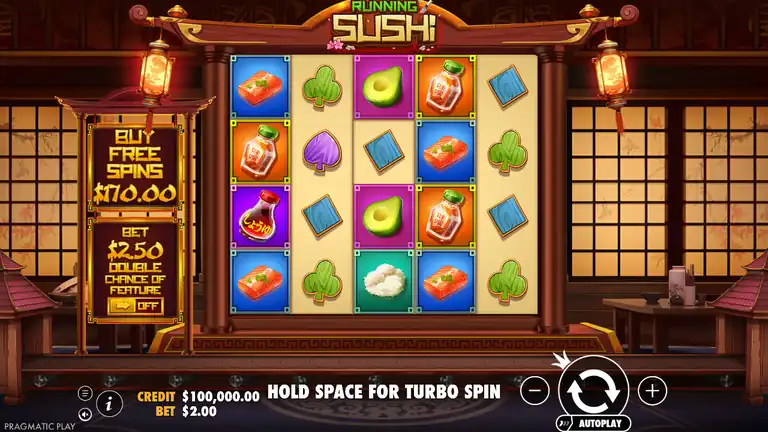
Two paid-entry options sit on the left panel during base play.
Buy Free Spins costs 85x stake. At a $2.00 bet that is $170.00 for one free spins round, which I could see displayed directly in the demo interface. Whether it makes sense depends on the bonus return: my 8 organic triggers in this session ranged from 9.25x to around 250x, with an average close to 99x. At 85x cost, roughly half of my bonus results would have been a loss on the buy. Buy Free Spins is not available in UK-regulated markets - standard Pragmatic Play restriction across their portfolio.
The Ante Bet adds 0.25x to each spin's cost, bringing the total to 1.25x base. At a $2.00 base bet that is $2.50 per spin. In exchange, the probability of triggering free spins doubles. I did not use the Ante Bet during my session; I kept the bet locked at $2.00 throughout.
My Session - 1,623 Spins at $2.00
I ran 1,623 spins in the Pragmatic Play demo at $2.00 per spin, keeping the bet fixed throughout. The session ran about an hour.
The first half was a grind. Hit rate came in around one paying spin in eight - close to the published figure, which means the base game produces regular small results but rarely anything substantial between bonus triggers. Dry runs rarely pushed past 30 to 40 consecutive non-paying spins; the longest gap I logged was 65 spins. The belt kept cycling - I watched values in the hundreds sit there for ten, fifteen spins at a stretch while Take Sushi stayed off the reels.
Eight bonus rounds fired across the session - roughly once every 202 spins, which ran above the published average of approximately one per 298. That above-average trigger rate made the difference between a losing and a profitable session. The bonus payouts varied sharply. Bonus 5 at spin 1,204 returned 9.25x across all 10 free spins - the weakest in the session, and well below the 85x cost of the buy option. Bonus 7 at spin 1,493 was the opposite: the accumulator built quickly through the early spins of the round and settled close to 250 times my stake. Four of the eight rounds came in above 68x; the other four returned 21x or under. Across all eight, the average sat close to 99x per trigger.
I closed out the session net positive in demo credits - the bonus cluster in the last few hundred spins pulled the balance well above where it started. Without those results it would have been a losing run. That is high volatility doing exactly what it does: a profitable session depends almost entirely on bonus timing and bonus quality.
During Bonus 7, I kept an eye on the ALL THE SUSHI meter on the left panel as the free spins ran. It started at zero and climbed as each Take Sushi event fed values into it across the first few spins. By the fourth spin of the ten it had already built to a substantial total; the rate of accumulation slowed in the back half of the round but what had already locked in was the session's highest result.
Observed RTP: (wagered $3,246 + net profit $724.30) / wagered = 122.31%. A single session at this scale is not predictive of long-run return.
Session Progression
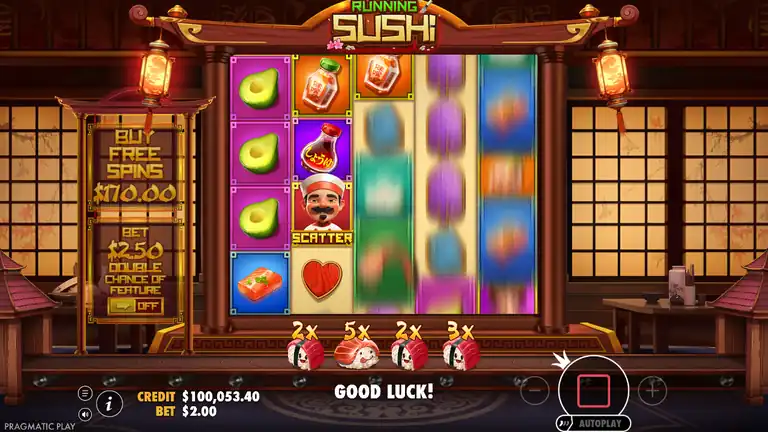
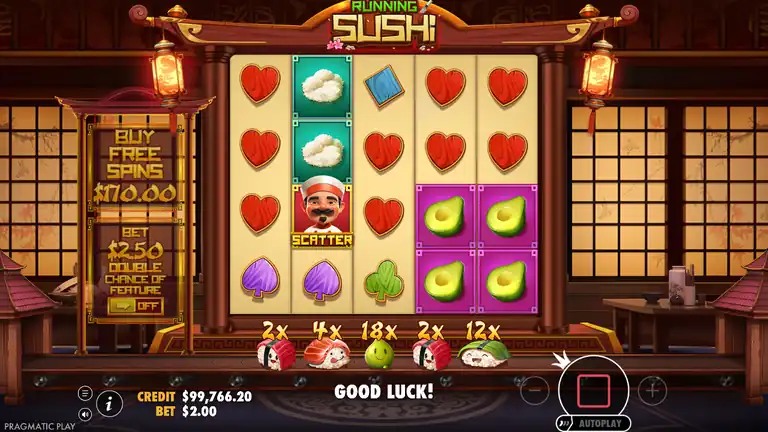
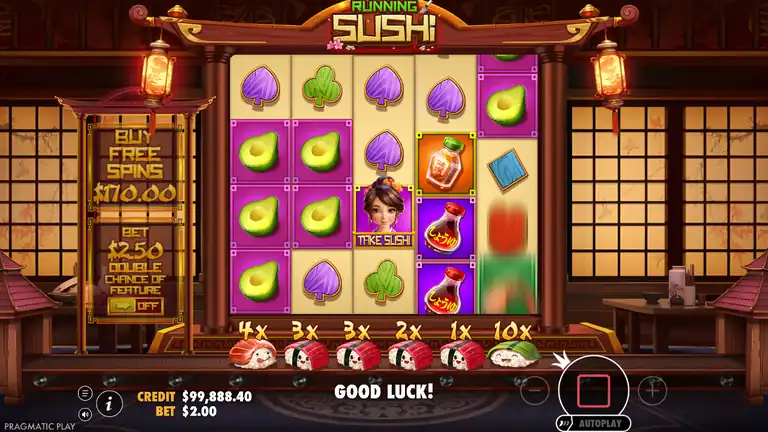
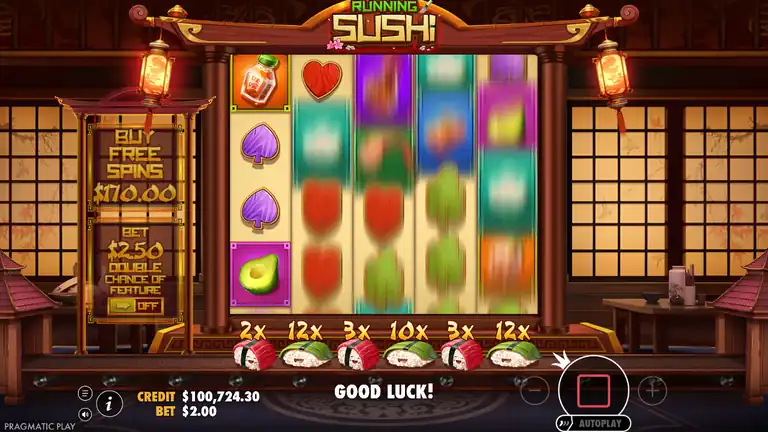
Test limitations: This was a single demo session of 1,623 spins using virtual credits, not real money. The session hit bonuses at a higher rate than the published average - that kind of run does not represent a typical session. The 3,000x theoretical maximum would require the Take All symbol to land when the meter has accumulated near-peak values from multiple high-value belt tokens - a compound event that did not occur in this session. One session at this scale is not enough to characterize long-run return.
Play Running Sushi Free Demo
The Pragmatic Play demo is available without registration. Use it to understand the conveyor belt mechanic and how Take Sushi versus Take All behave before committing real money.
No registration · Free play
18+ · Demo credits only · Results do not predict real-money returns
Pros and Cons
Pros
- RTP 96% published by Pragmatic Play on their official game page - documented and confirmed by Fruity Slots and VegasSlotsOnline
- Conveyor belt mechanic adds a secondary value layer to every base spin, not only the bonus round
- Buy Free Spins available at 85x stake where permitted (not UK-regulated markets)
- Published hit frequency (about one in seven base spins) keeps small wins landing between bonuses
Cons
- High volatility: published average bonus trigger of once per 298 spins means long waits between rounds are the norm
- Bonus payout range is extreme - 9.25x and around 250x came from the same 10-spin format within the same session
- No confirmed retrigger mechanic in free spins - 0 retriggers across all 8 bonus rounds in this session
- 3,000x max win ceiling is lower than comparable Pragmatic Play titles - Gates of Olympus reaches 5,000x, Sweet Bonanza 21,100x
- Collection timing is outside player control - a high belt value and no collector landing on the same spin yields nothing from the belt
How Running Sushi Compares
Running Sushi belongs to the Pragmatic Play money-collect category alongside Cash Bonanza and Sticky Bees. Its siblings use static money symbols on the reels; Running Sushi replaces the static layer with a moving belt that cycles independently below the grid - a structural difference that changes how the secondary prize layer behaves across a session.
| Game | Provider | RTP | Max Win | Grid | Mechanic |
|---|---|---|---|---|---|
| Running Sushi | Pragmatic Play | 96% | 3,000x | 5x4 | Conveyor belt collect |
| Big Bass Splash | Pragmatic Play | 96% | 2,100x | 5x4 | Fish collect (bonus) |
| Gates of Olympus | Pragmatic Play | 96.5% | 5,000x | 6x5 | Cluster pays + multipliers |
| Sweet Bonanza | Pragmatic Play | 96.48% | 21,100x | 6x5 | Scatter pays + multipliers |
Running Sushi vs Big Bass Splash
Both use a collector symbol to gather money values - the most useful comparison point. In Big Bass Splash, money fish sit directly on the reels during free spins and the Fisherman character - which acts as a wild substitute - sweeps its column to collect them. In Running Sushi, the belt runs independently below the grid and values cycle continuously. The mechanical difference: in Big Bass Splash the fish are there or they are not; in Running Sushi the belt values are always present, but a collector is needed to claim them. Big Bass Splash has a lower max win ceiling (2,100x vs 3,000x) but concentrates action into the bonus round more cleanly.
Running Sushi vs Gates of Olympus
Both are high-volatility Pragmatic Play titles where a single bonus round can range from nearly nothing to multiples of the stake. Gates of Olympus uses a 6x5 cluster-pays grid with per-spin multiplier orbs that stack across tumble steps. Running Sushi accumulates money values across multiple spins into a meter, without any multiplier stacking in the free spins. Gates of Olympus has a higher max win ceiling (5,000x vs 3,000x); Running Sushi's variance comes from the timing mismatch between belt values and collector landings across spins.
Frequently Asked Questions
What is the RTP of Running Sushi?
What is the maximum win in Running Sushi?
How do I trigger free spins?
What does Take All do?
Can I buy free spins in Running Sushi?
How volatile is Running Sushi?
Is a demo available for Running Sushi?
What bet sizes are available?
What is the difference between the base game and free spins in Running Sushi?

1,623 spins, Pragmatic Play demo, $2.00 fixed bet, June 2026. Originally published: June 2026.
For review methodology, see How we review slots · Report a correction
Where to Play Running Sushi
Running Sushi is available at MGA and UKGC-licensed casinos as part of Pragmatic Play's standard portfolio. Before committing real money, check the RTP variant the operator runs (94%, 95%, or 96% - not all casinos use the highest), whether the Buy Free Spins option is available (blocked in UK-regulated markets), and the minimum bet on offer.
Budget for at least 200 spins before expecting a bonus - published average is one per 298 spins.